
The Ember Attack: Why 85% of Businesses Will Be Disrupted By AI Before They See It Coming
The House That Didn't Burn From the Flames
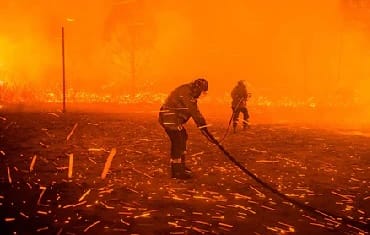
A few summers ago our brigade responded to a grass fire running hard through a dry paddock on a hot northwest wind. We had trucks on the flanks, a water bomber working the head and crews doing good work to contain it. From where I was standing, we had the situation under control. The main fire front was visible, it was moving in a predictable direction and we had a line ahead of it.
Then someone called it in over the radio. “We have a house on fire about six hundred metres from the main front.”
The family had done everything right. They'd cleared their gutters, they'd stayed to defend and they'd been watching the fire front just like the rest of us. What they weren't watching was their roof. An ember had landed on a pile of leaves in their gutters, caught quietly and worked its way into the roof cavity before anyone noticed. By the time smoke was visible the ceiling was already burning from the inside.
The main fire never touched that house. The embers did.
I want you to sit with that for a moment because it's exactly what's happening to your business right now.
You’re Watching the Wrong Place
Here’s the thing I see in almost every business I work with. You’re watching for the obvious signal. The big competitor announcement, the headline technology, the unmissable sign that tells you it’s time to act on AI. And your logic sounds completely reasonable. When the threat becomes real and visible you’ll respond to it.
Yes, that works if disruption arrives as a fire front on your doorstep. But ember attack doesn’t work like that and neither does AI disruption.
In windy fire conditions embers can travel kilometres ahead of the main front. They land on rooftops, in gutters, against fence lines and most of them go out but a few of them don’t. And the ones that don’t will burn your house down before you ever connect it to the fire you were watching four paddocks away. In fact, we know that it can even happen 20 minutes after the fire has passed your home!
That’s the AI disruption hitting your market right now. Not a single competitor is arriving to take your customers. Not one technology announcement states that you have six months to get ready. It’s dozens of small ignition points landing quietly inside your software, all around your business and most of them look too minor to worry about.
Suddenly one of your clients has switched from calling you, to handling that task themselves with an AI tool. A competitor you haven’t noticed yet has hired two people instead of eight and is pricing their service 30% lower than you. A prospect you’ve been nurturing for three months just signed with someone who closed them in three days using an AI-powered sales process. Each of these looks like a one-off and none of them feel like an emergency. But taken together they’re your roof cavity smouldering and you don’t know it yet.
You’re Facing a Extreme Fire Danger Day
Experienced firefighters don’t just watch the fire. They watch the conditions because the conditions tell you how far embers will travel and how fast they’ll ignite when they land. We’re constantly monitoring the wind, wind direction, humidity, temperature, fuel type and fuel load around us.
When I look at the conditions your business is operating in right now I see the worst combination I’ve seen in 41 years of watching technology reshape markets. Yes, I’ve been working on the cutting edge of technology since I was 16.
Your fuel load is enormous and you probably haven’t noticed it growing. Think about the processes running in your business right now that haven’t been seriously examined in years. Manual tasks, repetitive workflows, decisions made by people that could be automated but haven’t been because there was never a compelling reason to change. That’s dry kindling and most businesses are sitting on a lot of it.
The wind has picked up faster than most people realise. Eighteen months ago the AI tools that could genuinely automate complex business processes required an enterprise budget, a developer and months of implementation. Today they’re a monthly subscription you can set up in an afternoon on Make.com. The cost of deploying AI has collapsed and the accessibility has exploded. It’s in every phone and every computer.That means the competitive advantage that used to require serious capital is now available to anyone willing to spend a few hours learning and your competitors know it even if you don’t yet.
And the temperature in your market is high and rising. ChatGPT reached 100 million users in two months! The fastest consumer technology adoption in history. Worse still, that was all the way back in 2023… By the time most businesses finished their first internal discussion about whether AI was relevant to them their customers were already using it daily. The gap between businesses using AI seriously and businesses still discussing whether to is widening every month and it’s not going to close on its own.
Those three conditions together don’t describe a slow-moving threat you can monitor responsibly from a distance. That’s extreme fire weather and even a small ember could start a catastrophic fire.
What the Ember Attack Looks Like in Your Business Right Now
Let me be specific because ember attack sounds abstract until you recognise it happening in your own numbers.

AI Embers in 2020
AI Embers Today...
Think about a service business. A year ago a client was paying you for ten hours of work a month. They’re still paying you but the scope has quietly shrunk to four hours. They haven’t complained. They haven’t had a difficult conversation with you. They’ve just started using an AI tool to handle the parts they used to need you for and they bring you in for what they can’t manage yet. You won’t lose that client in a dramatic moment. You’ll just keep noticing the amount of work you do getting smaller until one day you realise it’s not worth keeping them as a client.
Or think about your pricing position. A competitor you’ve never heard of is now quoting jobs at your rate with faster turnaround. They’re not more experienced than you. They’ve just built a workflow where AI handles 60% of the production and they’ve passed the saving on to customers. They didn’t announce their arrival. They just started winning jobs you used to win and you’re not sure what you’re doing wrong.
Or think about your sales cycle. You’ve might have always operated on a three to four month close because that’s how long buyers in your space take to make decisions. A competitor has rebuilt their process using AI to personalise follow-up, surface the right proof at the right moment and answer objections before your second call has even happened. Their cycle is now six days. By the time you finish your first round of follow-up they’ve already signed your prospect.
In every one of those situations the ember landed months before the smoke appeared. That’s what makes ember attacks so dangerous. You won’t see it coming if you’re only watching for the fire front.
What You Need to Do Before the Roof Catches Alight
On the fireground when conditions are right for ember attack we don’t plant everyone on the main fire line and ignore everything else. We change our whole approach.
The first thing we do is put people on patrol. Not fighting the main front but specifically watching for spot fires landing ahead of the containment line. Your business needs the same thing. You need someone actively watching your competitive perimeter for AI all the time. Not a committee, not an annual strategy review and not a discussion saved for the next leadership offsite. One person, one brief, monitoring everything. What AI tools have just dropped that affect your market? What’s a competitor doing differently this month? What are your customers starting to do themselves that they used to pay for? Most businesses don’t have anyone doing this and it’s the single biggest gap I see.
The second thing we do is wet down the exposures before the embers arrive. We identify the surfaces most likely to catch and we prioritise those. Your version of this is identifying your two or three highest-risk processes, the ones that are most manual, most time-consuming and most easily replaced by an AI tool. Start your AI adoption there. Not everywhere at once and not a full transformation programme. Just wet down what’s most exposed and vulnerable first.
The third thing we do is reduce fuel load while we still have time. We don’t wait until a fire is running at us to clear the dry grass from around the building. We do it in the quiet periods so there’s less to burn when conditions turn bad. We can put in a blackburn or a bare earth line to remove the ground fuel. For your business that means auditing your workflows now while you have the headspace to make changes thoughtfully rather than reactively. What processes in your business are in danger of catching fire? What process would an AI tool replace first if a well-funded competitor decided to take that path tomorrow?
None of these steps require a big budget or a dedicated AI team. They require you to stop watching the horizon for a fire front that may never come and start patrolling for the embers that are already in the air.
The Question You Need to Answer Honestly
I think about that house often. The family did everything they were supposed to. They prepared, they stayed, they watched the threat they could see. What got them was the threat they weren’t watching for.
Most of the businesses that are going to be seriously disrupted by AI in the next three years won’t be hit by an obvious competitor or a dramatic technology shift. They’ll be hit by embers that have already landed and are quietly burning through the roof cavity while everyone watches the smoke in the distance.
So here’s the honest question. Not the comfortable version of it but the real one.
Are you watching your roof or just the smoke clouds?
Because the embers are already in the air, some of them have already landed and the conditions couldn’t be better for what comes next.
Start Here: Your 20-Minute Ember Audit
Don’t close this and move on. Do this first.
Open a blank document and write down every core process in your business that a human currently does manually. Then, next to each one write how many hours per week it takes your team. Circle the three that take the most time or are the most repetitive.
Then take each of those three and search for them right now with the words “AI tool” after them and see what already exists.
What you’re developing is your “fire plan”. It shows you exactly where the ignition risk is highest in your business and it takes less than twenty minutes to build. That’s where you start. You don’t start with a grand AI strategy or a big budget conversation, just an honest look at what’s most exposed.
The businesses that come through the next three years in good shape won’t be the ones with the biggest AI budgets or the most sophisticated strategies. They’ll be the ones that read the conditions early, patrolled their perimeter and dealt with the spot fires before they took hold.
Your roof is the most important thing to protect. Start checking it now.
Brad Hauck is an Australian volunteer rural firefighter and AI business consultant who has spoken in over 54 countries since 2009. He is the author of AI Powered Profits and the founder of the AI-Powered Authority Multiplier Mastermind.
SHARE


Every day you're not doing this, someone else is.
7 powerhouse AI prompts that turn what you know into content that gets you clients before you've spoken to a single person.
Created with ©systeme.io• Privacy policy • Terms of service